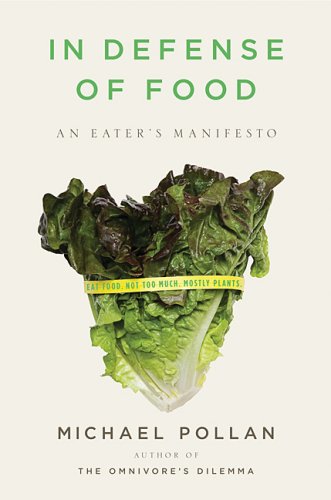
 Pollan's most recent book, In Defense of Food: an Eater's Manifesto, was my first dip into summer reading this year. After last summer's saga of the Omnivore's Dilemma I was ready for another journey in my fave subjectmatter: food! I would still definitely recommend both books to friends and strangers but I have to admit that i was not as dazzled by the recent Manifesto, potentially a helpful trait of the , ahem, digestibility of the book.
I did like that Pollan narrated with less of a first person in Manifesto. His central premise - that our ideological and material social frameworks have lead to partial perspectives, and thus partial knowledge and understanding, of food, nutrition, and health, is communicated with more focus when the discussion table is not cluttered with each personal detail of a mushroom hunt, for example. (To be fair, a freind told me that she read Pollan describes Omnivore as his poetry, while his other books are his prose.) The details of the power relationships between eaters, the indivisible governdustry, scientific experts and journalists is more concisely articulated in Manifesto. Pollan appropriately describes our foodways through our knowledge ways - what we know and don't know about the world dictates how we interact with it and how we normalize these interactions - thus how we justify who we are when we are what we eat.
I appreciate the attention he gave to the role journalists play in these knowledgeways and in our perception of health and food - they are the translators , the messengers bearing missives from the institutes and ivory towers of the world. And sometimes they get the message garbled, often actually, or simply need to create tension or a story where there isn't really one and thus the public is lured or lulled into the screwball politics that is our foodsystem. Unfortunately, Pollan in no way addresses how our media trains us to eat and perceive eating through gendered and static body image. When I was going to the gym every morning this winter, inevitably the 4 TV screens at the front of the cardio room were consistently running commercials that were either food, medication, law firms or insurance companies. All were telling you that you had cravings or bodily functions that you in no way should be expected to control and if anything backfired, (and it always would!) you could hire someone to pay or fight the battle for you. what a sham. This is the more salient side of journalism: advertising that poses as journalism. not to mention all the stigmas and stereotypes that tell us what healthy looks like. I'm supposed to be healthy as a 5'9" woman only if I'm 175lbs with a 6-pack and a 'fierce' tan. And I'm on my super-deluxo-gazellator-swingy-thingy-workout machine thinking thanks but no thanks to food fads, diet drugs, and skin cancer; that's not my definition of health.
This idealized body type - a static and ageless body with little or no fat - goes along with the reductionist thinking that Pollan presents as central to what he terms the Western diet. Nutritionism, the ideology that places the knowledge and power over understanding food in the hands of experts who define food as a set of nutrients devoid of a social, cultural, or environmental contexts, has lead us to believe that nutrients and food are the same thing when in fact they are not. Our job as eaters has become navigating the slippery food culture of contradicting ideals and realities always at the mercy of prevailing social, scientific, and environmental winds. And the result has largely been a decline in health of the entire population and environment, as well as a rise in what could be called 'apartheid eaters' - eating within certain boundaries such as no-carb, vegetarian, or sugar-free. I think Pollan would agree that these are symptomatic of basing our nutritionism insights on 'hard sceince' that in reality is pretty shaky and vastly unfinalized. Pollan describes this to a useful extent by touching on his role as a journalist in reporting new scientific prescriptions for this omega or that carb - scientists do not have the full story but journalists are supposed to and so the public is presented with the ultimatums of nutritionism as the media spins it. Pollan misses some of the key strands that effect our decision making, though, such as advertising and fashion magazines, like Shape, which present nutritionism ideology connected to gendered body images for women. The message is: reduce, reduce, reduce (meals reduced to carbs, protein, and angel/devil lipids, and bodies reduced to tan, hairless muscle) - a backup tune to the reductionist thinking that has brought us super-sugar-charged cereals endorsed with a stamp of approval by the American Heart Association (for a fee, of course).
In Manifesto, conscious consumption is what Pollan ultimately prescribes. I appreciate that Pollan didn't frame food or farmers as a moral and systemic ultimatum but rather a piece of a more complex whole that is culture, tradition, and social patterns that hang on or change over space and time. Omnivore's Dilemma presented a moral scale of food production whereas Manifesto gives you a more open system to work within, pointing out the efficacy and friction of ways of knowing and ways of eating rather than framing one foodway as a moral end in itself. But is it really more useful to posit that you may be how you eat, as well as what you eat? That is, can we define health as a term devoid of cultural and traditional contexts? Food is not an end in itself; peace, justice, equity and security are ends in themselves and food is a means to these ends - when framed as an end we easily lose sight of the alternatives that must be available to provide for all the unpredictable variations that are our social and environmental context. I think Pollan's points about food culture are helpful but not fully developed. It seems that Omnivore is his fleshed out vision of Western food culture, so in that way reading these books in tandem can be more effective. But is is useful to ultimately prescribe changes in the way we buy, alone?
This approach, an unspoken play of the neoliberal power card that is so popular in contemporary systemic critique, places the power of the consumer over that of the citizen. Instead of appealing to our quasi-democratically elected representatives to enforce a precautionary principle that releases their hands (both of them) from the corporate viselike grip that has become the norm, we are supposed to 'buy smart' and 'vote with our dollars'. This sounds a little like the 'power of positive thinking' that Marx criticized the Hegelians for. A poor man can think positively about his impoverished state all he likes - it still won't make him less hungry. Extending this, the power of positive consumption recommends we appeal to corporate agendas that in no way mean to take our desires into account unless we are shareholders - that is, they are not designed to listen to a popular voice with ends other than profit in mind. A majority who seeks change merely because they experience a cascade of negative externalities by picketing a corporate office rather than demanding the separation of corporation and state will continue seeking, I'm afraid, and exhaust themselves.
To be fair, conscious consumption is certainly an important and valid place to start - but again these actions are a means to an end - not an end in themselves. It is always critical to start where people are while keeping in mind a vision of where we could be. The power of positive thinking, or buying in Pollan's case, is only one direction from which to approach our multifarious agrofood-system and a more just, equitable, and secure community.


No comments:
Post a Comment